
Shipping Containers: A Complete Guide to Sizes, Prices, and Buying Smart

Shipping containers have led a double life for a few decades now. Their original job — moving cargo across oceans in standardized, stackable steel boxes — quietly revolutionized global trade in the mid-20th century. Their second job, as building modules, storage units, and the raw material for everything from backyard offices to luxury homes, has made them one of the more versatile objects a person can buy.
Whether you're buying a container for storage, for shipping, or as the starting point for a building project, the same fundamentals apply: understanding the sizes, the condition grades, the pricing, and what to check before you commit. This guide covers all of it.
Shipping Container Sizes and Dimensions
Shipping containers are built to ISO (International Organization for Standardization) specifications, which means dimensions are consistent worldwide. This standardization is precisely what made containers revolutionary, a container from any manufacturer fits any ship, truck, or crane designed for the standard.
20-foot standard container
External: 20' long × 8' wide × 8'6" tall
Internal: approximately 19'4" × 7'8" × 7'10"
Floor area: ~160 sq ft
The most common and versatile size. Manageable to transport, fits on most lots, and serves as the building block for compact structures.
40-foot standard container
External: 40' long × 8' wide × 8'6" tall
Internal: approximately 39'5" × 7'8" × 7'10"
Floor area: ~320 sq ft
The workhorse of international shipping and the most popular size for building projects that need more space than a 20-footer provides.
High cube containers (20' and 40')
Same footprint as standard containers but 9'6" tall (one foot taller)
Internal height: approximately 8'10"
The extra foot of height makes a significant difference for residential and habitable applications — it allows for a proper ceiling, insulation, and mechanical systems without feeling cramped. For building projects, high cube containers are almost always preferred.
Less common sizes
10-foot: compact, used for small storage and modular components
45-foot: extended length, used in some shipping and building applications
48-foot and 53-foot: primarily domestic US truck and rail containers, less common and not ISO standard for ocean shipping
For building projects, the 40-foot high cube is the most popular choice. The extra length and height maximize usable interior space and provide room for insulation without sacrificing headroom.
Shipping Container Condition Grades
Container pricing and suitability depend heavily on condition. The grading terminology isn't perfectly standardized across sellers, but these categories are widely used:
Brand new / one-trip Manufactured recently (typically in China, where most containers are made) and used for a single cargo shipment to reach the destination market. Near-perfect condition — minimal wear, clean interior, structurally pristine. The most expensive category but the best choice for building projects where structural integrity and appearance matter. "One-trip" is the term you'll see most often, functionally these are as-new containers.
Cargo-worthy (CW) - Certified structurally sound and watertight, suitable for continued international shipping. Shows wear consistent with years of use — surface rust, dents, scuffs — but no structural compromise. A good balance of cost and quality for many applications, including building projects where the exterior will be clad or finished.
Wind and watertight (WWT) - Sealed against wind and water intrusion, but not necessarily certified for ongoing cargo shipping. Suitable for storage and building projects. More wear than cargo-worthy, but still functionally sound.
As-is / used - Sold without condition guarantees. May have leaks, structural damage, or floor problems. The cheapest category and the riskiest — only appropriate if you can inspect thoroughly and the intended use tolerates imperfections.
For building projects specifically: one-trip containers are strongly preferred. The premium over used containers is worth it for the structural certainty, clean starting condition, and absence of cargo history concerns (used containers may have carried chemicals requiring remediation before residential use).
Shipping Container Prices in 2026
Container prices fluctuate significantly with global shipping demand, steel prices, and regional supply. The ranges below reflect typical US market conditions but can shift.
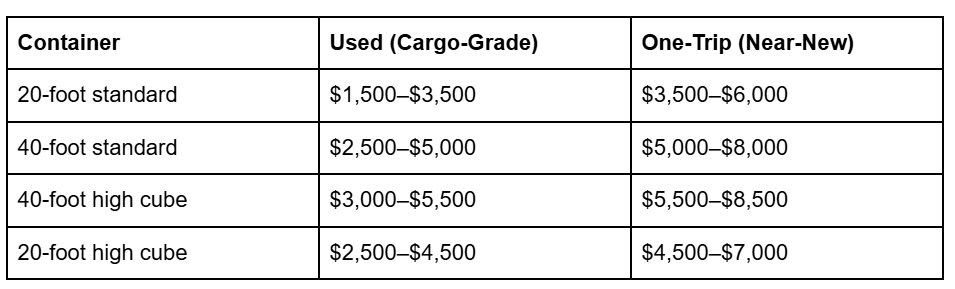
Factors that affect price:
Location. Containers are cheapest near major ports (Los Angeles, Long Beach, Savannah, Houston, New York/New Jersey) where supply is highest. Inland locations pay more due to transport costs — moving a container from a port to an inland location can add $500–$3,000.
Delivery. Container delivery requires specialized equipment (a tilt-bed truck for placement, or a crane for precise positioning). Delivery costs typically run $200–$800 for local delivery, more for longer distances or crane placement.
Market timing. Container prices spiked dramatically during the 2020–2022 supply chain disruptions and have since normalized. Prices remain sensitive to shipping demand and steel costs.
Modifications. Containers with existing modifications (doors, windows, ventilation) cost more than unmodified units.
What to Inspect Before Buying
Whether buying for storage or building, inspect (or have inspected) these elements before committing:
Structural integrity. Check all four corner castings, the roof rails, and the frame for dents, bending, or cracks. Minor surface dents are cosmetic; structural deformation compromises the container's load-bearing capacity and weathertightness.
Roof condition. Container roofs collect water and are prone to rust and pooling damage. Inspect from above if possible — climb up or use a ladder. Standing water stains, rust patches, and dents that create pooling are warning signs.
Floor condition. Container floors are typically marine plywood or bamboo, often treated with pesticides for cargo protection. Check for soft spots, rot, gouges, and chemical staining. For residential building projects, floors frequently need replacement or encapsulation regardless of condition due to the chemical treatment.
Door operation. The doors should open, close, and seal properly. Check the rubber gaskets for cracking and the locking mechanisms for smooth operation. Rusted or bent door frames are difficult and expensive to repair.
Rust assessment. Surface rust is normal and manageable on used containers. What matters is whether rust has penetrated through the steel (creating holes or structural weakness) versus remaining superficial. Tap suspicious areas — solid steel sounds different from rust-thinned metal.
Cargo history (for used containers). Ask about the container's cargo history and request the CSC (Container Safety Convention) plate information. Containers that carried food-grade or general dry cargo are lower-risk; containers that carried chemicals, pesticides, or hazardous materials require remediation before residential use.
Watertightness. Close the doors and check from inside for daylight penetration — any visible light indicates a gap that will admit water. For a more thorough test, spray the exterior with a hose and check for interior leaks.
Buying for a Building Project vs. Storage
The intended use significantly changes what you should buy and what matters.
For storage: A used cargo-worthy or wind-and-watertight container is usually sufficient. Cosmetic wear doesn't matter; what matters is that the container is dry inside and the doors seal. This is the most cost-effective application of used containers.
For a building project (home, office, studio): The calculus shifts significantly toward one-trip containers. Building a habitable, code-compliant, long-lasting structure on a compromised container is a false economy — the labor and materials that go into the conversion far exceed the container cost, so starting with a structurally pristine, clean container protects that larger investment. High cube containers are strongly preferred for the extra ceiling height, and cargo history matters because residential occupancy requires addressing any chemical contamination.
For serious building projects, many buyers skip the container-sourcing process entirely and work with a manufacturer who builds finished structures from properly specified containers. This eliminates the risk of buying a compromised container and the complexity of managing the conversion process.
From Container to Building: The Manufacturer Route
For anyone considering a container as the basis for a home, office, studio, or other habitable structure, there's an important decision: source the container and manage the conversion yourself, or buy a finished structure from a manufacturer who handles the entire process.
The self-managed route gives maximum control and potential cost savings, but requires sourcing quality containers, arranging structural modifications, managing insulation and finishing, and navigating permits — a substantial project with real risk of costly mistakes.
The manufacturer route delivers a finished, engineered structure built from properly specified containers. Companies like Prefahb build residential and commercial structures from one-trip containers at their facility, handling container sourcing, structural engineering, insulation, and finishing as an integrated process. Prefahb's models — from the Model B201 (from $29,000) to the Model R404 (from $195,000) — start from properly specified containers and arrive as complete, code-compliant structures, eliminating the container-sourcing risk entirely for buyers who want the end result rather than the project.
For buyers whose interest in shipping containers is ultimately about creating a building, understanding the container fundamentals in this guide helps evaluate manufacturer offerings, but the manufacturer route typically delivers a better result with far less risk than self-sourcing and self-converting.