
Prefab ADU: The Fastest Way to Add a Unit to Your Property
The math on an ADU has never been better. In a housing market where rental rates in most US metros are at all-time highs, and the cost of adding a unit through traditional construction has climbed relentlessly, a well-chosen prefab ADU can pay for itself in four to seven years — and generate income for decades after.
The appeal isn't just financial. Multigenerational living, housing a caretaker, creating a dedicated home office, giving an adult child a place to land — these are real needs that a backyard unit serves better than almost any alternative.
The question most property owners get stuck on isn't whether an ADU makes sense. It's how to actually get one built without the process becoming a multi-year ordeal. Prefab changes that equation significantly.
What Makes a Prefab ADU Different
A prefab ADU — whether that's a panelized kit system, a modular unit, or a container-based structure — is manufactured off-site while site preparation work happens in parallel. By the time the unit arrives, your foundation is poured, your utility stub-outs are in place, and you're ready for installation in a matter of days.
Compare that to site-built ADU construction, where every phase is sequential: design, permits, foundation, framing, rough electrical and plumbing, inspections, and interior finish. Each phase waits for the previous one to complete. The total timeline regularly stretches to twelve to eighteen months.
A prefab ADU compresses that to eight to fourteen weeks from deposit to installation in most cases — sometimes faster.
The other significant difference is cost predictability. Site-built construction is famously susceptible to cost overruns — material prices shift, subcontractors run late, and weather causes delays. Prefab pricing is largely locked in at the point of order. The surprises, when they happen, come from site conditions, not the unit itself.
Types of Prefab ADU
Not all prefab ADUs are the same product. Understanding the categories helps you evaluate what you're actually buying.
Modular ADU units are built in a factory to the same building codes as site-built homes. They arrive in one or more modules, fully finished inside, and are craned onto a permanent foundation. These are classified as real property and eligible for conventional financing.
Panel system ADUs use prefabricated wall and floor panels assembled on-site. Faster than traditional framing, but requiring more on-site labor than a fully modular unit. Good option for sites with difficult access that can't accommodate a crane.
Container-based ADUs use shipping containers as the structural shell, finished to residential standards. The inherent steel structure is rigid and durable; the challenge is achieving good thermal performance, which requires careful insulation detailing. On the upside, steel containers are vandal-resistant during construction, easy to relocate if needed, and structurally inherently suited to single-story or stacked two-story configurations.
Prefahb's Model B201 (from $29,000) works particularly well as an ADU application. Built from a 20'–40' shipping container, it arrives with the wood deck, murphy bed, and fold-down desk integrated — practical features for a rental or guest unit. The Nomadic Package adds solar and a wood-burning stove, making it fully off-grid capable for rural properties where extending utility connections is expensive.
Prefab ADU Costs: The Honest Breakdown
There's a wide range in the market, and the "starting at" prices advertised by most companies don't reflect all-in costs. Here's a realistic picture:
Unit cost: $30,000–$150,000+ depending on size and finish level.
Foundation: $5,000–$25,000. Concrete pier systems are typically cheapest; full perimeter foundations cost more. Soil conditions and local code requirements drive this.
Site preparation: $3,000–$20,000. Grading, access prep, clearing. Varies dramatically by lot conditions.
Utility connections: $5,000–$30,000. Extending water, sewer, and electrical service from the primary residence to the ADU. Costs escalate sharply for lots where the primary home's service panel is near capacity or utilities require trenching across significant distances.
Permits and fees: $2,000–$15,000. Varies by jurisdiction. California cities generally run higher due to plan check fees, school impact fees, and utility connection charges.
Delivery and installation: $3,000–$15,000. Crane placement for modular or container units, assembly labor for panel systems.
All-in realistic range:
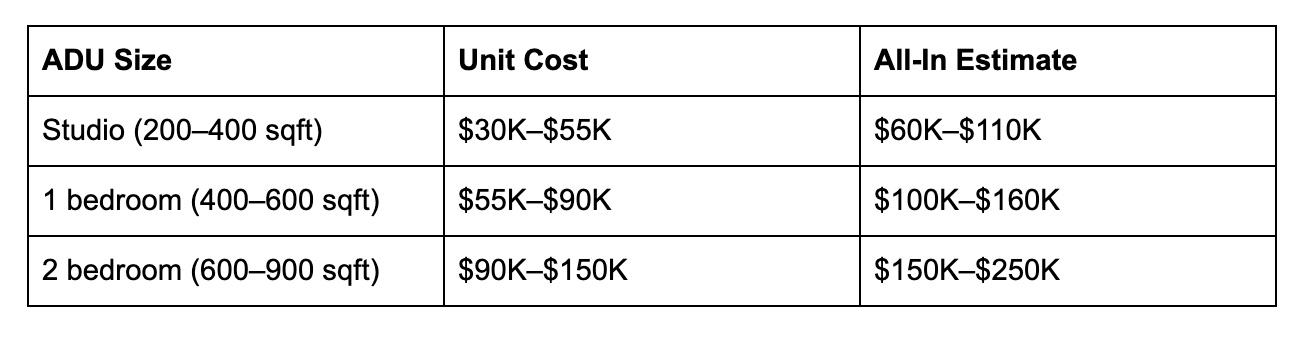
These ranges are US national averages. California and Pacific Northwest metros are consistently at the upper end or above.
ADU Permitting: What You Actually Need to Know
The regulatory environment for ADUs has improved substantially since California's landmark ADU legislation in 2017 and 2020, which other states have partially followed. But it's still not simple.
What's required everywhere: Building permit, foundation inspection, framing/installation inspection, electrical inspection, plumbing inspection, final inspection before occupancy. Prefab manufacturers should provide stamped structural drawings that satisfy the building department's plan review requirements.
What varies by jurisdiction: Setback requirements (how far the ADU must sit from property lines), maximum size limits, owner-occupancy requirements, design compatibility requirements (some HOAs and zoning codes require ADUs to match the primary home's exterior), and fee structures.
California specifically: AB 68 (2020) requires most jurisdictions to approve ADU applications within 60 days. It prohibits owner-occupancy requirements in most cases and limits impact fees for units under 750 sqft. This has made California, counterintuitively, one of the more ADU-friendly regulatory environments in the country
What to do before purchasing anything: Pull up your parcel on your local jurisdiction's zoning portal, confirm the zoning allows ADUs, and check the setback requirements for your specific lot. A pre-application meeting with the planning department costs nothing and saves significant time.
Container ADU Legality
This question comes up often enough to address directly. Shipping container structures are legal as residential ADUs in the vast majority of US jurisdictions. They're treated as conventional construction for permitting purposes — they need to meet the same energy code, electrical, plumbing, and egress requirements as any other residential structure.
A handful of jurisdictions have explicit restrictions or require variance approval for container structures. These are the exception, not the rule. Confirming with your local building department before purchasing is always the right move.
The more common issue isn't legality — it's aesthetics. Some HOAs and some design-review overlay zones require ADU exteriors to be compatible with the primary residence. A raw steel container may trigger a design review; a container ADU finished with wood cladding or stucco typically doesn't.
The ROI Case
Let's be concrete about this, because the numbers are genuinely compelling in most US markets.
A well-sited ADU in a medium-cost US market (Austin, Denver, Portland, Phoenix) can generate $1,500–$2,500/month in long-term rental income. In high-cost metros (LA, SF, Seattle, NYC), the range is $2,000–$4,500/month.
Against an all-in cost of $100,000–$150,000 for a quality 1-bedroom prefab ADU, the payback period at $2,000/month rental income is roughly four to six years. After that, you're generating net income on an asset that also adds to your property's resale value — ADUs increase home values in most markets by 20–30% of the ADU's construction cost.
The calculation doesn't always work — rural properties, low-rental-demand markets, and sites with very high utility extension costs can change the math significantly. But for a typical suburban lot in a US city with housing demand, the financial case for a prefab ADU is strong.
Getting Started
The process for buying a prefab ADU follows the same sequence as any prefab home purchase: define your use case, confirm zoning, get a site assessment, compare manufacturers on transparency and included specs, then commit.
The unique wrinkle for ADUs is the utility connection planning, confirm early what's involved in extending service from your primary home, because this is where ADU project costs most commonly exceed initial estimates.
Prefahb's process begins with a site evaluation and refundable deposit, so you know exactly what you're committing to before the build payment is locked in.
Browse Prefahb's model lineup to find the right prefab ADU for your property.