
A-Frame Prefab House: Why This Shape Keeps Coming Back
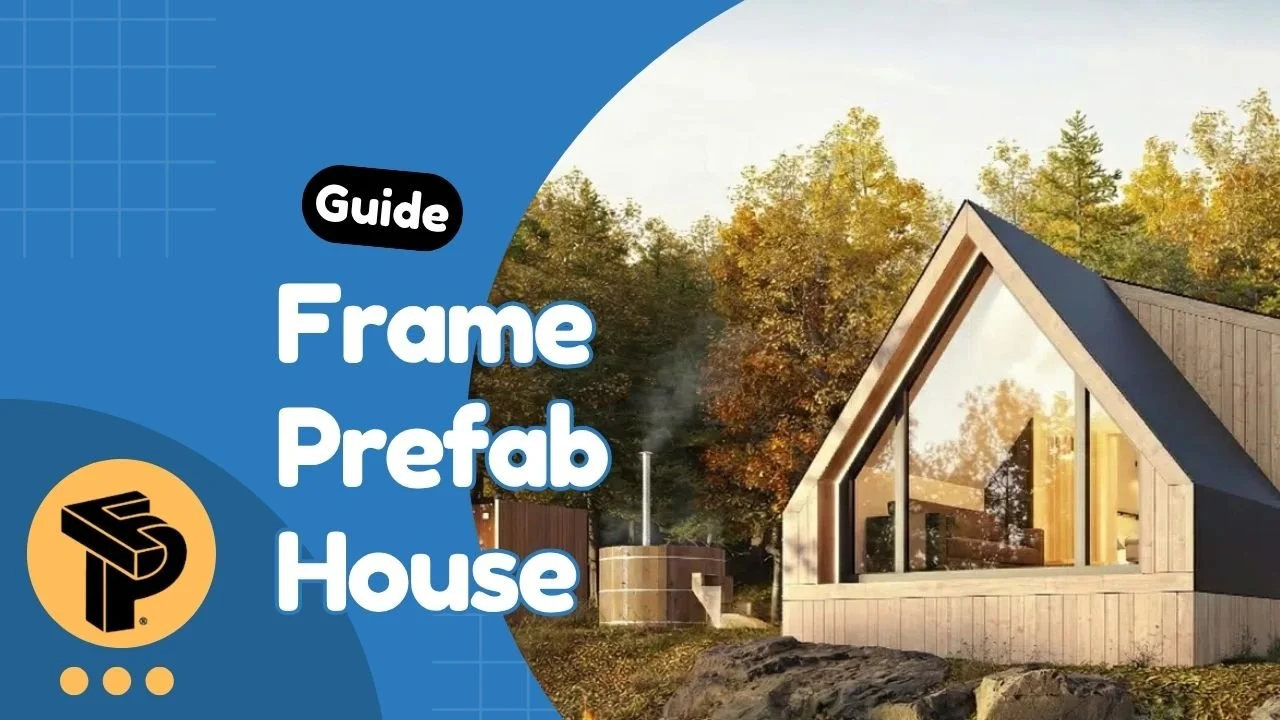
There's something about the A-frame that refuses to go away. Every decade or so, design trends shift — the farmhouse rises, the ranch falls, the modern box takes over — and yet the A-frame is always there, waiting. A triangle on a landscape. Steep roof touching the ground, glass filling the gable ends, a loft hanging above everything.
It's not nostalgia. The shape is genuinely good at several things that other house forms aren't, and prefab manufacturing has made it more accessible than it's been at any point since the 1960s cabin kit era. Here's what you should know.
Why the A-Frame Works
Before getting into kits and costs, it's worth understanding why the A-frame remains compelling rather than just treating it as an aesthetic choice.
The roof IS the wall. In a conventional house, the roof sits on top of the walls. In an A-frame, the roofline extends all the way to — or close to — grade level. This eliminates the need for a separate wall structure over a significant portion of the building, which simplifies construction and reduces material cost relative to the enclosed volume.
Structural efficiency in snow. The steep pitch — typically 60 degrees or more for a true A-frame — sheds snow rather than letting it accumulate. For mountain cabins and high-latitude builds, this isn't just aesthetic preference: it's engineering. A flat or low-slope roof in a heavy snow zone requires substantial structural capacity to handle the load. An A-frame roof simply doesn't collect it.
Dramatic interior volume for the footprint. The vaulted interior of an A-frame creates the spatial feeling of a much larger home. The loft — the natural byproduct of the triangular cross-section — adds usable floor area without expanding the footprint. In areas with strict square footage limits or small lots, this matters.
The glass gable end. Standard A-frame design places large glazed openings at both ends of the structure. This creates cross-ventilation in summer and, when properly oriented, solar gain in winter. It's also just visually striking in a way that's hard to replicate with conventional wall openings.
What "A-Frame Prefab Kit" Actually Means
The term is used loosely, so it's worth being precise.
At one end, a structural kit includes the engineered frame components — typically laminated timber rafters and ridge beam, floor framing, and connection hardware — packed flat and shipped to site. Everything else (sheathing, insulation, windows, interior finish) is sourced locally or added as options. These are the most DIY-friendly and the most work-intensive.
In the middle are panel kit systems — structural insulated panels (SIPs) or prefabricated wall/roof panels that arrive sized and cut for the specific design. These dramatically reduce on-site labor time. A two-person crew with a small crane can often raise the structural shell in a day or two.
At the other end are near-complete prefab A-frames — units that arrive largely finished, needing only foundation placement, utility connections, and minor site work. These sacrifice some customization for speed and predictability.
Most buyers are better served by panel systems or near-complete units unless they have genuine construction skills and are specifically interested in the build process.
A-Frame Prefab Designs: What's Available
The classic A-frame has evolved considerably. Current prefab offerings range from the traditional steep-pitch cabin form to more contemporary interpretations that use the basic triangular cross-section as a starting point and depart from there.
Traditional A-frame cabins. The original form — steep pitch, compact footprint, loft bedroom, open main floor. Works best on wooded lots where the vertical profile fits naturally. Typically 400–800 square feet of usable space, though the vaulted ceiling makes it feel larger.
Modern A-frame with shed additions. Many contemporary designs add a shed-roofed wing or rectangular volume to the base A-frame, creating a hybrid form with more flexible floor planning. The main volume retains the dramatic roofline; the addition provides conventional bedroom or utility space without the awkward triangular corners.
Micro A-frames. The intersection of the tiny house movement and A-frame design has produced a range of very compact units — 200 to 400 square feet — that work as vacation rentals, backyard structures, or off-grid cabins. These are where the prefab kit model works best: small enough to ship efficiently, simple enough to assemble with basic skills.
Contemporary A-frame homes. Full-size, architect-designed A-frame prefab homes intended for permanent residence are the upper tier of the market. Multi-story, 1,200–2,500 square feet, with the kind of detailing and finish quality that competes with custom construction.
A-Frame Prefab Costs: What to Expect
Costs vary significantly by kit type, size, and finish level. Here's a realistic range:
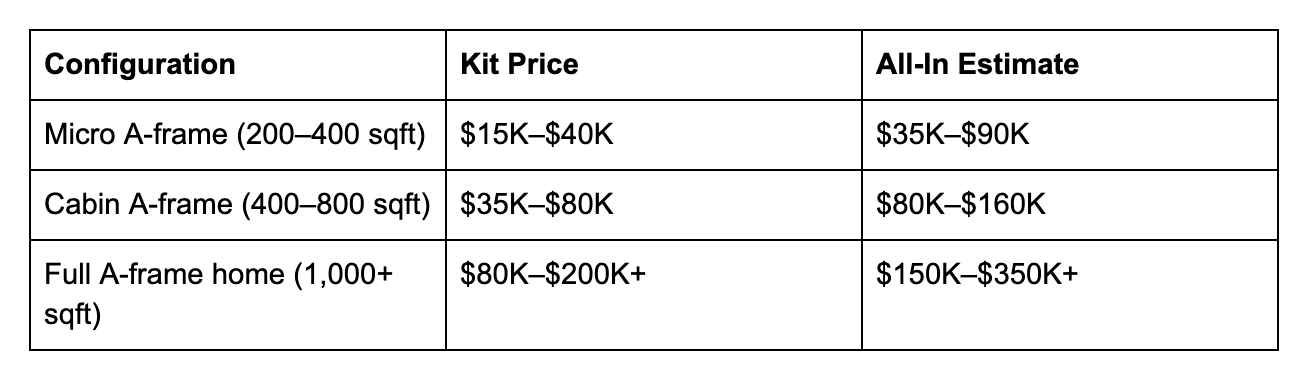
The all-in estimate accounts for foundation, site prep, shipping, assembly labor, utility connections, and finishing. These costs are real and shouldn't be underestimated — particularly for mountain or remote sites where access adds significantly to delivery and crane costs.
What drives cost upward most reliably: highly remote sites, steep terrain, heavy snow load engineering requirements, premium glazing, and high-end interior finishes.
What keeps cost down: smaller footprint, simpler site conditions, willingness to handle some finish work yourself, proximity to manufacturer.
A-Frame vs. Container Prefab: Different Tools for Different Jobs
If you're researching A-frame prefab alongside container home options, here's the honest comparison.
A-frame wins on: dramatic interior volume, visual impact on forested or mountainous sites, snow performance, the romantic association with cabin living.
Container homes win on: structural robustness for shipping, flexibility of configuration (multi-unit stacking), lower cost at equivalent square footage for pragmatic living spaces, and a more straightforwardly modern aesthetic.
They're not in direct competition. An A-frame makes sense when the shape itself is part of what you want — the soaring interior, the glass gable view, the mountain cabin feeling. A container home makes more sense when you're optimizing for cost efficiency, modularity, or a more minimalist architectural language.
Prefahb's container-based lineup — from the Model B201 (from $29,000) through the Model R404 (from $195,000) — covers the range of what container architecture can do at different scales and price points. If you're drawn to the modular, horizontal aesthetic rather than the vertical drama of the A-frame, that's worth exploring as an alternative.
Buying an A-Frame Prefab Kit: What to Check
Before committing to any A-frame kit, verify these things specifically:
Snow load engineering. If your site gets significant snowfall, confirm the kit is engineered for your local ground snow load (available from your county or the ASCE 7 standard). Not all kits are engineered for high-load zones.
Insulation specification. The roofline of an A-frame covers a large surface area relative to the floor area, which makes thermal performance especially important. Look for R-values of at least R-38 in the roof assembly for four-season use in cold climates.
Foundation requirements. A-frame structures transmit loads through the base of the rafters to the foundation. The foundation design needs to account for outward thrust at the rafter bases — a detail that simple slab-on-grade foundations sometimes don't handle well. Confirm your manufacturer provides foundation drawings that address this specifically.
Window/door specifications. The large gable-end glazing in an A-frame is both its defining feature and its biggest potential energy liability. Triple-pane glazing adds cost but pays back in comfort and heating bills in cold climates.
The Bottom Line
The A-frame prefab has earned its endurance. It's a structurally logical form, a visually compelling one, and prefab manufacturing has made it accessible without sacrificing the craftsmanship that makes a good A-frame worth building.
Whether you're looking at a micro cabin for a mountain lot, a full-time residence with a dramatic interior, or something in between, the current prefab kit market has more serious options than at any previous point.
If the A-frame's vertical drama and forest-cabin associations are exactly what you want, it's a category worth pursuing seriously.