
Oversized Couch: How to Choose One That Fits Your Room and Delivers Real Comfort

There's a specific kind of comfort an oversized couch provides that a standard sofa simply can't. The deep seat that lets you fold your legs up or stretch out fully. The generous proportions that make sinking in feel like an event rather than just sitting down. The sense that the furniture is genuinely built for relaxing rather than for perching politely.
But an oversized couch is also one of the easier furniture purchases to get wrong. Too big for the room and it dominates the space, blocks circulation, and makes everything else feel undersized. Wrong proportions and it looks awkward. Poor construction and the deep, soft comfort you were chasing turns into a sagging, shapeless mess within two years.
Here's how to get it right — the sizing, the quality, and the styles that actually deliver.
What "Oversized" Actually Means
The oversized couch category isn't precisely defined, but it centers on a few consistent characteristics:
Deep seats. The defining feature. Standard sofa seat depth is 21–25 inches. Oversized and deep-seat couches run 40 inches or more. This depth is what enables the lounging posture — sitting back fully with legs up or extended, rather than sitting upright with feet on the floor.
Generous overall proportions. Oversized couches are typically wider, taller, and more substantial than standard sofas. They have visual weight and presence in a room.
Plush, generous cushioning. Often (though not always) associated with soft, deep cushioning — the "cloud couch" aesthetic of deep, pillowy seats and backs that you sink into.
The category includes several related types: deep-seat sofas (standard length, extra depth), oversized sectionals (large L or U configurations), and cloud-style couches (emphasizing soft, plush cushioning). What they share is the prioritization of lounging comfort over upright seating and formal proportion.
The Critical Sizing Conversation
More than any other furniture purchase, oversized couches go wrong on sizing. The couch that looked reasonable in a cavernous showroom overwhelms a normal living room. Getting this right is the single most important part of the decision.
Measure your room, then measure again. The three measurements that matter:
The couch footprint vs. the room. As a general rule, seating should occupy no more than two-thirds of the room's length along any wall. An oversized couch in a small room breaks this rule dramatically and makes the space feel cramped.
Clearance around the couch. Allow at least 30–36 inches of walkway clearance around the seating area for comfortable circulation, and 18 inches between the couch and coffee table.
The delivery path. This is where oversized couches most commonly create problems. Measure every doorway, hallway, stairwell, and turn the couch must navigate to reach the room. Oversized couches are large and often can't be disassembled — many buyers have discovered too late that their new couch physically won't fit through the door. Confirm the couch can be delivered before purchasing, and ask whether it comes in sections or with removable components.
Room size guidelines:
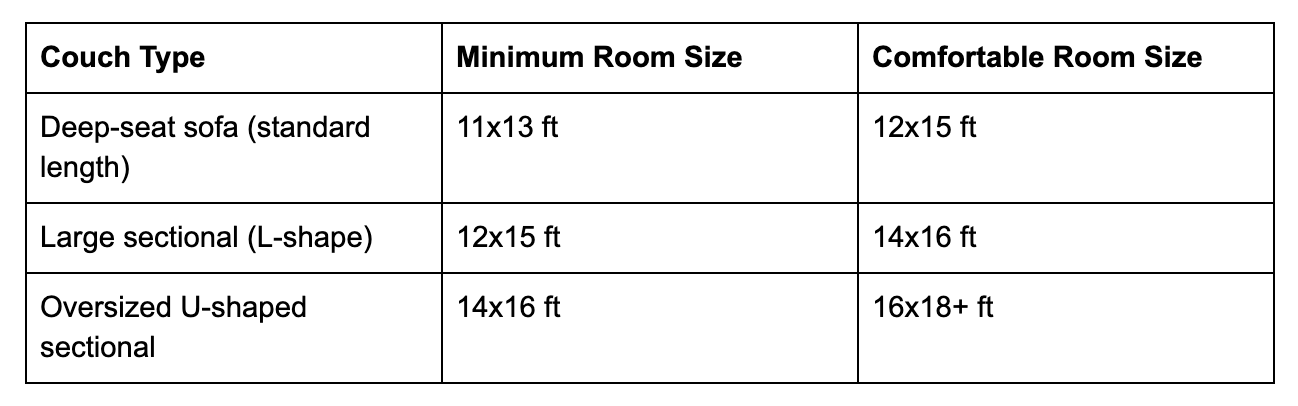
Tape it out. Before buying, use painter's tape to mark the exact footprint of the couch on your floor. Live with the taped outline for a few days — walk around it, sit within it, see how it affects the room's flow. This simple step prevents the most common and expensive oversized couch mistake.
The Comfort Trade-Off You Need to Understand
Oversized deep-seat couches involve a genuine trade-off that buyers should understand before purchasing: they optimize for lounging at the expense of upright seating.
The deep seat that makes lounging luxurious means that an average-height person (5'4"–5'10") cannot sit upright with their back against the backrest and their feet flat on the floor — the seat is simply too deep. To sit upright, you either perch on the front edge (uncomfortable and defeats the purpose) or use additional back cushions to effectively reduce the seat depth.
This means oversized deep couches work brilliantly for:
Lounging, relaxing, watching TV or movies
Napping and casual sprawling
Households where the living room is primarily for relaxation
And work less well for:
Upright seating and formal conversation
Households with elderly members who find deep, low, soft couches hard to get out of
Rooms adjacent to dining areas where upright posture matters
Small-statured people who feel "swallowed" by very deep seats
The solution many buyers use is a generous supply of back cushions that can be added to reduce effective seat depth when upright seating is wanted, then removed for full lounging. If you're drawn to an oversized couch but need it to work for upright seating too, prioritize a model that comes with substantial, well-made back cushions.
Quality: What Separates a Good Oversized Couch from a Sagging Disappointment
Oversized couches are especially vulnerable to quality problems because their generous proportions and soft cushioning can mask structural weakness — until the couch starts sagging and losing shape a year or two in. The larger the couch and the softer the cushioning, the more the underlying quality matters.
Frame construction. The frame is the foundation. Look for:
Kiln-dried hardwood (maple, beech, ash, poplar) — stable, holds fasteners, won't warp. The gold standard.
Avoid particleboard, MDF, or low-grade softwood frames — they fail at joints under the sustained loads a large couch endures.
Joinery should be reinforced: corner blocks, dowels, screws and glue — not just staples.
A quality oversized couch frame is heavy. If a large couch feels surprisingly light, the frame is likely inadequate.
Suspension system. What holds up the seat:
Eight-way hand-tied springs — premium, durable, excellent support. Best for large couches where the load is significant.
Sinuous (serpentine) springs — good quality with heavy-gauge wire; the standard in most quality couches.
Webbing alone — inadequate for oversized couches; will sag under the sustained load.
Cushion fill. This is where oversized couch comfort lives and dies:
The best oversized couches use a high-resilience foam core (2.0+ lb/cubic ft density) wrapped in a softer layer of down or down-alternative. This gives the plush, sink-in feel while maintaining support and shape.
Pure down/feather cushions feel luxurious but flatten quickly and need constant fluffing to maintain shape.
Pure low-density foam feels firm initially and compresses permanently over time — the source of the sagging that plagues cheap oversized couches.
Ask specifically about the cushion fill construction. "Premium cushioning" tells you nothing; "high-resilience foam core wrapped in feather-down blend" tells you what you're actually getting.
The sit test. In person, sit and — importantly — get up. Notice whether the cushion returns to shape immediately or holds a compression. Press firmly into the seat and back; you should feel supportive resistance, not bottom out onto the frame. Sit for several minutes; some couches feel great for thirty seconds and uncomfortable after five minutes.
Oversized Couch Styles
Deep-seat sofa. Standard sofa length (typically 84–96 inches) with extra-deep seats (40+ inches). Fits where a standard sofa would but delivers the lounging depth. Good choice for rooms that can't accommodate a full sectional but want the deep-seat comfort.
L-shaped oversized sectional. A long section plus a chaise or shorter perpendicular section. The most versatile oversized configuration — provides both upright-ish seating on the main run and full-lounge space on the chaise. Works in most medium-to-large living rooms and creates a natural conversation area.
U-shaped sectional. Three sections forming a U — the maximum-capacity oversized couch, seating six to eight people in a contained, inward-facing arrangement. Requires significant floor space and works best in large, dedicated media or family rooms. Creates a strong social gathering zone but dominates any room it's in.
Cloud-style couch. Emphasizing soft, plush, pillowy cushioning — deep seats, soft down-wrapped cushions, a relaxed, slightly slouchy aesthetic. The ultimate lounging couch. The trade-off is that the very softness that makes them appealing requires quality construction to avoid premature sagging, and they need regular cushion fluffing to maintain their look. Prioritize quality fill construction (high-resilience foam core, not pure down) for a cloud couch that stays beautiful.
Modular oversized systems. Sectionals built from individual modules that can be rearranged. Flexibility is the appeal — reconfigure as needs change, add modules over time, or separate for moving. Quality of the connection hardware between modules matters for long-term stability.
Fabric Considerations for Oversized Couches
Oversized couches see heavy use — they're where people spend the most relaxed, casual time, often with food, drinks, kids, and pets. Fabric durability matters more here than on a formal sofa.
For heavy-use oversized couches, prioritize:
Performance fabrics (solution-dyed synthetics, Crypton, Revolution) for households with kids or pets — stain-resistant, cleanable, durable.
High double-rub ratings — 50,000+ for family use.
Removable, washable covers where possible — a significant practical advantage for the couch that gets the most spills and wear.
For lower-use or more formal contexts, natural fabrics (linen blends, velvet, or leather) offer more luxurious hand feel and aesthetic character, with the understanding that they require more careful use and maintenance.
Given how much life happens on an oversized couch, many buyers find that a quality performance fabric — which now comes in genuinely attractive textures and colors — is the practical choice that keeps the couch looking good through years of real use.
Making the Decision
The oversized couch that you won't regret is the one that: fits your room with proper clearance (taped out and confirmed before buying), can actually be delivered to the room, matches your real use (lounging-focused, with back cushions if upright seating matters), is built on a quality hardwood frame with proper suspension and high-resilience foam-core cushions, and is upholstered in a fabric that suits your household's actual use.
Get those right and an oversized couch delivers exactly what it promises: the most comfortable seat in the house, and the place everyone gravitates toward. Get them wrong and it becomes an expensive, room-dominating source of daily minor frustration. The difference is entirely in the decisions made before purchase.
Discover Prefahb's Bali-crafted furniture and natural home collections.