
How Much Is a Prefab House? Real Costs Broken Down for 2026
Let's skip the vague answers. If you've been Googling "how much is a prefab house" and keep landing on pages that say "it depends" without actually telling you anything — this is the article you were looking for.
Yes, it does depend on a few things. But we're going to tell you exactly what it depends on, what realistic numbers look like at each level, and what you should budget for beyond the sticker price.
The Short Answer
A prefab house in 2026 costs anywhere from $5,000 to $250,000+, depending on size, configuration, finish level, and where you're installing it. That's a wide range, so let's break it down properly.
Entry-Level Prefab: $5,000 – $35,000
This is the territory of single-unit, compact prefab structures — think studio-sized container homes, backyard offices, she sheds, and small guest quarters.
At this price point, you're typically looking at:
160–340 square feet of living space
A single room with basic utility hookups
DIY-friendly assembly with minimal site prep
Optional add-ons like solar panels or a murphy bed
Prefahb's Model B201, for example, starts at $29,000 and comes as a 20'–40' knock-down shipping container unit with a wood deck, murphy bed option, and upgrade packages for solar and garden roofing. It's the kind of entry point that makes prefab genuinely accessible without sacrificing build quality — hand-crafted in Ubud, Bali and shipped directly to your site.
The Model BT201 ($4,950) and Model Z201 ($5,950 — a folding container design) sit even lower, making them compelling choices for anyone testing the waters before committing to a full build.
Mid-Range Prefab: $35,000 – $100,000
This is where most buyers land when they want a proper living space — not just an auxiliary unit, but something you could realistically call home.
At this tier, expect:
400–900 square feet
One to two bedrooms
Full kitchen and bathroom
Higher-quality insulation, finishes, and structural integrity
Faster delivery compared to traditional construction (often 8–16 weeks)
Prefahb's Model H201 (from $39,000) and Model P201 (from $59,950) sit squarely in this range. These are shipping container-based homes built for full residential use, with customization options that let you dial in the aesthetics — whether you're going minimal and modern or leaning into a Balinese-influenced design.
For comparison, a traditionally built home of similar size in the US typically runs $150,000–$300,000 when you factor in labor, materials, permits, and timeline delays. Prefab cuts that significantly.
Premium Prefab: $100,000 – $250,000+
At the upper end, prefab homes compete directly with custom construction — and often win on speed, consistency, and sustainability.
What you get here:
Multi-container configurations (two to four units combined)
Open-plan living with high ceilings and large glass facades
Premium finishes, smart home integration, rooftop decks
Architect-designed floor plans built for permanent residence
Prefahb's Model F (from $113,000), Model A2030 ($91,200), Model P202 ($109,995), and Model R404 (from $195,000) represent this tier. These aren't just homes — they're statements. The R404 in particular is designed for buyers who want luxury container living without compromise.
What the Sticker Price Doesn't Include
This is the part most prefab articles gloss over. The unit price is real, but it's not the total cost. Here's what to budget for on top:
Site preparation — Grading, foundation work, and utility connections can run $10,000–$50,000 depending on your land and local requirements.
Shipping and delivery — Transporting a prefab unit from the manufacturer to your site adds cost. For international builds like Prefahb's Bali-crafted models, freight is factored into the quote process.
Permits and inspections — Varies widely by state and county. Budget $2,000–$10,000 for permitting, especially in places like California where codes are stricter.
Installation labor — Even DIY-friendly units need a crane and crew for placement. Factor in $3,000–$15,000 depending on complexity.
Finishing and hookups — Plumbing connections, electrical panels, HVAC, interior finishing work. Add $5,000–$30,000 depending on how turnkey your unit arrives.
So, How Much Does It Really Cost to Build a Prefab House?
A realistic all-in budget for a quality prefab home in the US looks like this:
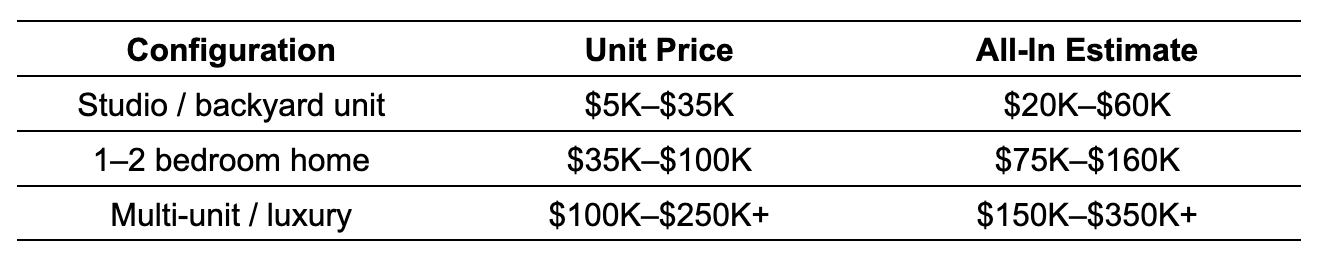
The gap between unit price and all-in cost is real — but even at the top of that range, prefab typically undercuts traditional construction by 20–40%.
Is a Prefab Home Worth It?
For most buyers asking this question in 2026, the answer is yes — particularly if you value speed, sustainability, and cost predictability. Unlike traditional construction where budgets balloon mid-project, prefab pricing is largely locked in upfront.
The key is choosing a manufacturer who's transparent about what's included and what isn't. Prefahb's process, for instance, starts with a refundable deposit and a site evaluation before any commitment is locked — so you know exactly what you're getting into before the 50% build deposit kicks in.
If you're ready to see what's available at different price points, explore Prefahb's full model lineup here.