
Hot Tents: What Makes a Good One and How to Choose the Right Setup
Winter camping used to mean suffering. A three-season tent rated to 20°F, a sleeping bag you're afraid to leave, and the constant calculation of how long you can stay in your bag before the cold becomes genuinely dangerous. Hot tent camping is a different experience entirely — fire inside, real warmth, the ability to sit up and cook and read and stay out longer than your body would otherwise allow.
The concept isn't new. Canvas wall tents with wood stoves have been used by hunters, trappers, and military expeditions for well over a century. What's new is the current generation of purpose-designed hot tents that have made the setup lighter, more packable, and more accessible to backpackers and weekend campers who wouldn't have considered a traditional canvas wall tent.
Here's how they work, what to look for, and how to build a setup you'll actually use.
What Makes a Tent a "Hot Tent"
Any tent can theoretically be used with heat — but a hot tent is specifically designed for it. The defining feature is the stove jack: a heat-resistant port built into the tent fabric through which the stovepipe exits the tent while keeping the shelter sealed around it.
A properly designed stove jack uses silicone, fiberglass, or other heat-resistant material at the entry point, surrounded by reinforced tent fabric that won't burn or melt from the stovepipe's radiated heat. The stovepipe passes through the jack, bends upward outside the tent to create draft, and carries combustion gases and smoke away from the interior.
Without a stove jack, putting a wood stove inside a tent is genuinely dangerous, either the pipe heat damages the tent fabric, or you're forced to crack a gap large enough for the pipe that eliminates the warmth you were trying to create.
Hot Tent Materials: Canvas vs. Polycotton vs. Synthetic
The material choice defines a hot tent's performance profile more than almost any other factor.
Canvas (cotton duck) is the traditional hot tent material and still preferred by many serious cold-weather campers. Its advantages are significant: natural breathability means moisture vapor from breathing and cooking escapes through the fabric rather than condensing on the interior walls; it's naturally fire-resistant compared to synthetic fabrics; it develops good water resistance when wet (the fibers swell and close); and it feels genuinely warm and substantial in a way synthetics don't. Canvas is heavy — a large wall tent can weigh 30–60 lbs — which matters for backpacking but less for basecamp or vehicle-supported camping.
Polycotton (cotton/polyester blend) splits the difference. Lighter than pure canvas, with better water resistance out of the box, and retaining most of the breathability advantage of natural cotton. A polycotton hot tent weighs roughly 30–40% less than a comparable pure canvas tent for similar protection. Most mid-range hot tents use polycotton blends for this reason.
Silnylon and synthetic fabrics produce the lightest hot tents — some ultralight designs weigh under 2 lbs including stove jack. The trade-off is reduced breathability (leading to more condensation), higher sensitivity to spark damage (synthetic fabrics melt rather than char), and a generally less robust feel. Ultralight synthetic hot tents are optimized for fastpacking and multi-day trips where pack weight is the primary constraint.
For most buyers — particularly those setting up basecamp-style winter camps for hunting, fishing, or recreational winter camping — polycotton is the practical sweet spot.
Hot Tent Types and Shapes
Wall tents are the traditional hot tent form — large, rectangular, with nearly vertical walls that maximize usable interior space. The classic hunting camp canvas wall tent falls in this category. Sizes range from 8'x10' (comfortable for two people with a stove) to 16'x20' (capable of sleeping 8–10 and functioning as a genuine expedition shelter). Heavy but enormously capable; typically set up with a pole frame or suspended from a ridge line between trees.
Tipi/lavvu tents are conical or slightly offset-conical designs that shed wind and snow exceptionally well. The sloped walls radiate heat back toward the center where the stove sits, which is efficient. They're typically lighter than wall tents of comparable capacity because there's no vertical wall structure to support. The central pole placement requires positioning the stove slightly off-center to keep the living space practical.
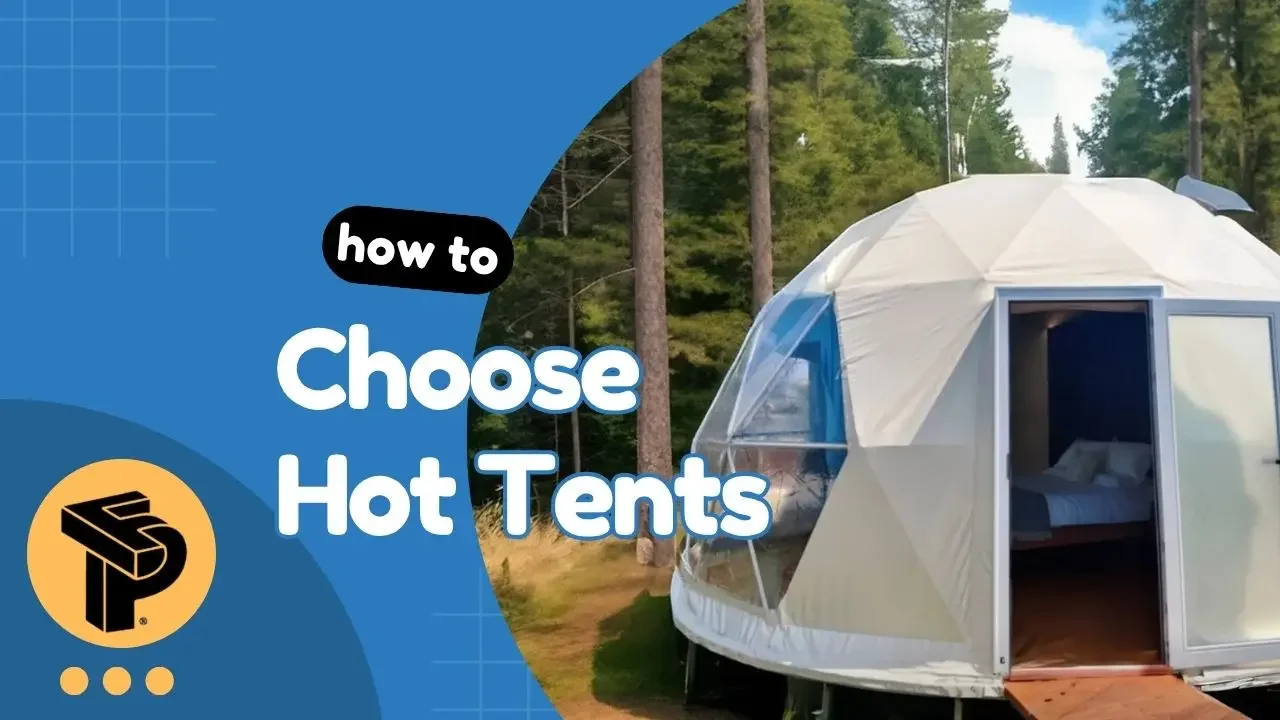
Tunnel and dome hot tents use flexible pole structures to create freestanding designs without trees or external poles. Generally lighter than wall tents, easier to pitch in open terrain, and available in sizes from solo (compact enough for backpacking) to family (4–6 person capacity). The most accessible entry point into hot tent camping for most buyers.
Pyramid/mid tents — a single center pole with steeply sloped sides. Very fast to pitch, inherently stable in wind, and available in designs from ultralight solo versions to larger group sizes. The steep sides limit usable headroom near the edges but create good snow-shedding geometry. A popular choice for winter mountaineering and ski touring applications.
The Stove: What to Look For
The tent stove is the other half of the system, and it deserves as much attention as the tent itself.
Size matching. The stove needs to be appropriately sized for the tent volume. An undersized stove won't heat effectively in severe cold; an oversized stove overheats the tent and wastes fuel. Most manufacturers provide recommendations for their stoves based on tent volume (length × width × average height). For a medium-size hot tent (8'x10'), a stove with a 2,500–4,000 cubic inch firebox is typically appropriate.
Material: steel vs. titanium. Steel stoves are heavier (5–15 lbs depending on size) but retain heat well and are considerably cheaper than titanium. Titanium stoves are lightweight (sometimes under 2 lbs for compact designs) and heat up very quickly, but are significantly more expensive ($300–$800 vs. $100–$300 for comparable steel stoves) and cool down faster when the fire dies. For basecamp use where weight isn't the primary concern, steel is the sensible choice. For backpacking, titanium's weight savings justify the cost.
Cooking surface. A flat top surface is the most versatile cooking option — allows a pot or pan to sit stably and provides an evenly heated surface. Some tent stoves include a removable secondary surface level for more complex cooking. If cooking on the stove is important to your use case, verify the top surface dimensions accommodate your cookware.
Stovepipe sections. The stovepipe needs to extend above the tent exterior to create proper draft. Most systems use sections of 2–3 inch diameter pipe that connect and lock together. Ensure you have enough sections to reach at least 12–18 inches above the tent roof once the pipe exits the stove jack — insufficient height creates poor draft and smoking interiors.
Spark arrestor. A spark arrestor screen on top of the stovepipe prevents embers from landing on the tent fabric. Essential for canvas and polycotton tents, which will burn if hit with a live ember. Many quality tent stoves include this; if not, it's a $10–$20 add-on that's worth having.
Safety: The Non-Negotiable Basics
Hot tenting is genuinely safe when done correctly. These rules are non-negotiable:
Only use tents with purpose-designed stove jacks. Improvised solutions — cutting holes in regular tents, rigging pipe through a door gap — are fire hazards. If the tent wasn't designed for a stove, don't use it with one.
Maintain clearance at the stove jack. The stovepipe should not contact the stove jack material. Most jacks are designed with a metal ring that the pipe passes through with clearance. Check periodically during use that the pipe hasn't shifted to contact the surrounding fabric.
Ventilate. Carbon monoxide is colorless and odorless and can build up in a sealed tent even with a properly drafting stove. Always leave at least one small vent open — a partially unzipped door or a dedicated vent — to allow fresh air circulation. A CO detector inside the tent is strongly recommended.
Never leave a stove unattended overnight. Let the fire die down before sleeping. An unattended stove burning hot while everyone sleeps is a fire risk and a CO risk. Many experienced hot tent campers use a damped-down stove to provide low heat through the night, maintained consciously rather than set and forgotten.
Have a clear exit plan. Know which direction your tent door opens and how quickly you can get out. In the unlikely event of a fire, seconds matter.
Building Your Hot Tent Setup: What to Budget
Hot tent: $300–$1,500
Budget canvas or polycotton: $300–$500 (adequate for occasional use, heavier)
Mid-range polycotton: $500–$900 (the practical sweet spot for most buyers)
Premium canvas wall tent or ultralight titanium: $900–$1,500+
Tent stove: $150–$600
Steel backpacker stove: $100–$200
Medium steel basecamp stove: $150–$350
Titanium stove: $300–$600
Stovepipe sections: usually included with the stove, but confirm. Add $30–$80 if buying separately.
Ground insulation: An insulated ground cloth or foam pad under your sleeping area dramatically reduces heat loss to the ground — more important for comfort than the stove in some conditions. Budget $30–$100.
CO detector: $20–$50. Non-optional.
Total realistic budget for a quality complete setup: $500–$2,000 depending on tent size, material, and stove specification.
The Prefahb Connection: Hot Tents and Off-Grid Living
Hot tent camping sits in the same philosophical neighborhood as off-grid prefab living — simplicity, self-sufficiency, comfort that doesn't depend on infrastructure. It's no coincidence that buyers exploring container homes with off-grid packages (like Prefahb's Nomadic Package, which includes a wood-burning stove as part of the off-grid energy system) often find themselves drawn to hot tent camping as well.
The wood-burning stove as a heating source works on the same principle in a canvas tent at 10°F as it does in a Prefahb container home at a remote mountain site: radiant heat, available fuel, no grid dependency. The experience of being genuinely warm in a cold environment through your own preparation is the same in both contexts.
For buyers building toward an off-grid or minimal-infrastructure lifestyle, hot tent camping is both a practical skill and a genuine enjoyment in its own right.
Explore Prefahb's off-grid capable container home models with wood-burning stove packages.