
Shipping Container Homes: The Complete Guide for 2026

Shipping container homes have moved well past the novelty phase. What started as an architectural curiosity, a few designers repurposing industrial steel boxes into habitable spaces, has become a legitimate segment of the US residential market, with thousands of units built annually and a growing ecosystem of manufacturers, builders, and financing options.
If you're researching container homes for the first time, there's a lot of noise to cut through. This guide covers what actually matters: how they're built, what they realistically cost, where they're legal, and what to look for when choosing a manufacturer.
What Is a Shipping Container Home?
A shipping container home is a residence built using one or more ISO-standard intermodal shipping containers as the primary structural element. The containers, typically 20 or 40 feet long, 8 feet wide, and 8'6" or 9'6" tall, are modified and finished to residential standard, with insulation, electrical, plumbing, windows, and interior finishes added to the steel shell.
The containers used are either:
New (one-trip) containers — used once to ship cargo from the factory to a destination, then sold before re-entering the shipping cycle. These are in near-perfect condition and carry no cargo history concerns, but cost more than used containers.
Used (cargo-grade) containers — retired from active shipping service, typically 10–15 years old. These are more affordable but should be inspected for structural damage, rust, and chemical residue from previous cargo before use in residential construction.
The steel shell provides the structural frame of the home. Unlike conventional wood-frame construction, there's no need for a separate load-bearing wall system — the container itself carries the loads.
How Shipping Container Homes Are Built
Understanding the construction process helps you evaluate manufacturer claims and anticipate what's involved in your project.
Step 1: Container selection and inspection. Containers are inspected for structural integrity, floor condition, and cargo history. Any chemical treatment used to preserve flooring in cargo containers (typically pesticides) needs to be addressed before residential use — either by replacing the floor entirely or through encapsulation.
Step 2: Cutting and modification. Openings for windows, doors, and connection points between containers are cut using plasma or laser cutting equipment. This is where factory production has a significant advantage over site-based modification — precision cuts made in a controlled environment produce cleaner results and don't compromise structural integrity the way imprecise field cutting can.
Step 3: Structural reinforcement. Wherever the steel shell is cut — particularly for large window and door openings — structural steel headers and frames are welded in to restore the load path. This is engineering work that needs to be properly designed, not improvised.
Step 4: Insulation. The most critical step for container home performance. Options include closed-cell spray polyurethane foam (sprayed to the interior surface, combining insulation and vapor barrier), rigid foam boards, or exterior continuous insulation with a rain screen. Closed-cell spray foam is the most common choice for container interiors because it adheres directly to the steel, provides excellent R-value per inch (R-6 to R-7 per inch), and eliminates the condensation risk that uninsulated or poorly insulated steel creates.
Step 5: Mechanical rough-in. Electrical conduit, plumbing supply and drain lines, and HVAC ductwork are installed within the insulation layer or in interior wall framing built inside the container.
Step 6: Interior and exterior finishing. Interior walls are typically framed with light-gauge steel or wood studs against the insulated shell, then finished with drywall, paneling, or exposed surfaces. Exterior finishes range from painted steel to wood cladding, stucco, or composite panels.
Step 7: Multi-container connection. For homes using multiple containers, the connection points between units are engineered steel joints that provide structural continuity and weathertight sealing.
Shipping Container Home Sizes and Configurations
The standard container dimensions define the planning vocabulary of container architecture.
20-foot container: 160 sqft of floor area. Works as a studio, home office, small vacation cabin, or one of several units in a larger configuration.
40-foot container: 320 sqft of floor area. The most common unit for single-container homes is enough for a studio or an efficient one-bedroom layout.
40-foot high cube: Same footprint as the standard 40-foot, but 9'6" tall instead of 8'6". The extra foot of ceiling height makes a significant difference in how the interior feels and how much usable wall space is available above furniture.
Multi-container configurations:
Side-by-side: Two or more containers placed parallel to create wider floor plans (a single container is only 8 feet wide — two side-by-side give you a 16-foot-wide room).
End-to-end: Containers joined end-to-end to create longer floor plans.
Stacked: Containers placed on top of each other for two-story configurations.
Offset/cantilevered: Containers offset horizontally to create overhangs, covered outdoor spaces, and more complex architectural forms.
The combination of these configurations is where container architecture gets genuinely interesting. An L-shaped arrangement of four 40-foot containers creates a 1,280-sqft footprint with an interior courtyard. A two-story stacked configuration of six containers creates a substantial family home with a relatively small ground-floor footprint.
What Shipping Container Homes Cost
Costs break into two categories: unit cost and all-in project cost.
Unit cost (the container home as manufactured and delivered):
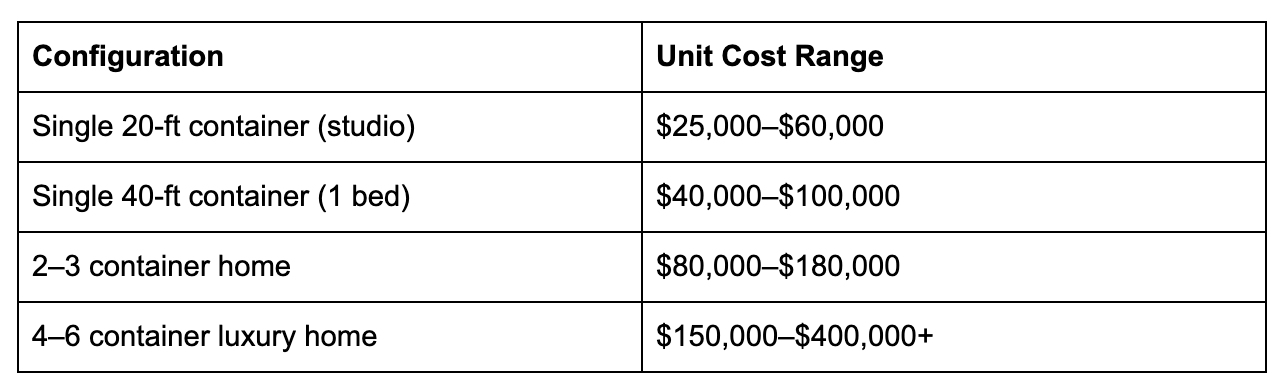
All-in project cost (including site prep, foundation, shipping, installation, utility connections, permits):
Add 40–70% to the unit cost for a realistic all-in budget. A $60,000 container home unit realistically costs $90,000–$100,000 all-in on a well-prepared site, more on challenging terrain or in high-cost jurisdictions.
Prefahb's lineup spans this range: the Model B201 starts at $29,000 for a studio-scale unit; the Model R404 starts at $195,000 for a multi-container luxury configuration. All-in costs for US buyers are higher due to international shipping, which Prefahb factors into the project quote process.
Are Shipping Container Homes Legal?
Yes, in the vast majority of US jurisdictions — but with conditions.
Container homes must meet the same local building codes as any other residential structure: energy code compliance (insulation R-values, window performance), electrical code, plumbing code, fire safety, and egress requirements. The container itself doesn't exempt you from any of these; it's the structural starting point, not a regulatory shortcut.
What to confirm before purchasing:
Zoning: Is residential use allowed on your parcel? Are container structures explicitly permitted, restricted, or simply unaddressed (which usually means they're treated as conventional construction for permitting purposes)?
Setbacks: What are the required distances from property lines, and does your site accommodate the container's dimensions within those setbacks?
Foundation requirements: Most jurisdictions require a permanent foundation for a residential structure to be classified as real property. The foundation type (slab, piers, helical piles) will be specified by the building department.
HOA: If your property is in an HOA, confirm the CC&Rs don't restrict non-traditional construction materials or require design compatibility with neighboring homes.
Choosing a Shipping Container Home Manufacturer
The manufacturer you choose determines more about your outcome than almost any other decision. Here's what to evaluate:
Real photos of completed projects. Not renders, not concept images. Real photos of homes they've actually built and delivered. This is the minimum standard for any serious manufacturer.
Structural engineering documentation. The manufacturer should provide stamped structural drawings from a licensed engineer for every build. These are required for permitting and are your assurance that the cuts and modifications have been properly accounted for structurally.
Transparent, itemized pricing. What's included in the unit price? What triggers additional cost? What will you need to source locally? A manufacturer who can't answer these questions with specific numbers is transferring risk to you.
Cargo inspection process. How does the manufacturer inspect and address used container cargo history? What's their policy on containers with documented chemical treatment?
US delivery and installation support. If you're buying from an international manufacturer — which can offer significant value, as Prefahb's Bali-based production demonstrates — confirm they have a structured process for US delivery, customs clearance, and installation support.
Payment structure. Phased payment tied to build milestones protects both parties. Prefahb's process: refundable deposit → site evaluation → confirmed quote → 50% non-refundable build deposit → 40% before shipping → 10% on delivery.
The Honest Tradeoffs
Shipping container homes have real advantages: structural strength, design flexibility, speed of delivery, sustainability credentials, and cost efficiency relative to equivalent custom construction. They also have real limitations that deserve acknowledgment.
Width constraint. A single container is 8 feet wide. Combined containers address this, but it's a planning constraint that shapes every floor plan.
Thermal performance requires attention. Steel conducts heat. Without proper insulation, a container home performs poorly in both hot and cold climates. This is solvable — but it requires deliberate engineering, not an afterthought.
Stigma in some markets. A small number of jurisdictions and communities have aesthetic or zoning biases against container structures. This is diminishing as the category matures, but it's worth confirming locally.
Not DIY-simple. The structural modifications, insulation installation, and multi-container connections require real construction knowledge. "Build it yourself from YouTube videos" is not a realistic path to a safe, code-compliant container home.
These are manageable limitations, not dealbreakers — but they're worth understanding before you commit.
Why Shipping Container Homes Make Sense in 2026
The US housing market in 2026 presents a clear case for container homes: construction costs are high, skilled labor is scarce, timelines for conventional construction are long, and the affordability gap between average incomes and average home prices remains historically wide.
Container homes address all of these directly: lower cost, faster delivery, less dependence on on-site skilled labor, and a quality ceiling that has risen dramatically as the manufacturing ecosystem has matured.
For buyers willing to engage seriously with the process — site assessment, manufacturer selection, permitting — the result is a home that delivers genuine quality at a cost that conventional construction can't match.
Explore Prefahb's full container home lineup from studio to luxury configurations.