
How Much Is a Modular Home? Real Costs Broken Down for 2026
The number you see advertised and the number you actually pay are rarely the same thing with modular homes. A manufacturer's "starting at $80,000" means the base unit before the land, foundation, delivery, installation, utility connections, permits, and finishing that turn it into a place you can actually live.
This is the cost breakdown that shows you both numbers, clearly.
The Short Answer
A modular home in 2026 costs $100,000–$400,000+ for the unit alone, depending on size and finish level. All-in project costs — everything it takes to go from bare land to move-in — typically run $150,000–$500,000+.
That's a wide range, so here's what determines where you fall within it.
Modular Home Costs by Size
Size is the biggest single driver of modular home cost, so it makes sense to start there.
Small modular homes (under 1,000 sqft): Unit price: $80,000–$150,000 All-in estimate: $130,000–$230,000
These are one to two-bedroom configurations — right-sized for individuals, couples, vacation properties, or downsizers. At this footprint, modular construction offers particularly strong value: the efficiency of factory production shows up most clearly in compact, well-designed plans where every square foot has a job.
Mid-size modular homes (1,000–1,800 sqft): Unit price: $150,000–$280,000 All-in estimate: $230,000–$420,000
The most common size range for family modular homes. Three bedrooms, two bathrooms, a functional kitchen, and living areas. This tier is where modular most directly competes with site-built construction on value — typically delivering equivalent quality 20–30% cheaper and 40–60% faster.
Large modular homes (1,800+ sqft): Unit price: $250,000–$500,000+ All-in estimate: $380,000–$700,000+
Larger family homes, high-specification builds, and custom-equivalent modular. At the upper end of this range, the cost advantage over site-built construction narrows, but the speed and quality consistency advantages remain.
Modular Home Costs Per Square Foot
Per-square-foot figures are useful for rough budgeting and comparison, but treat them as approximations rather than precise quotes.
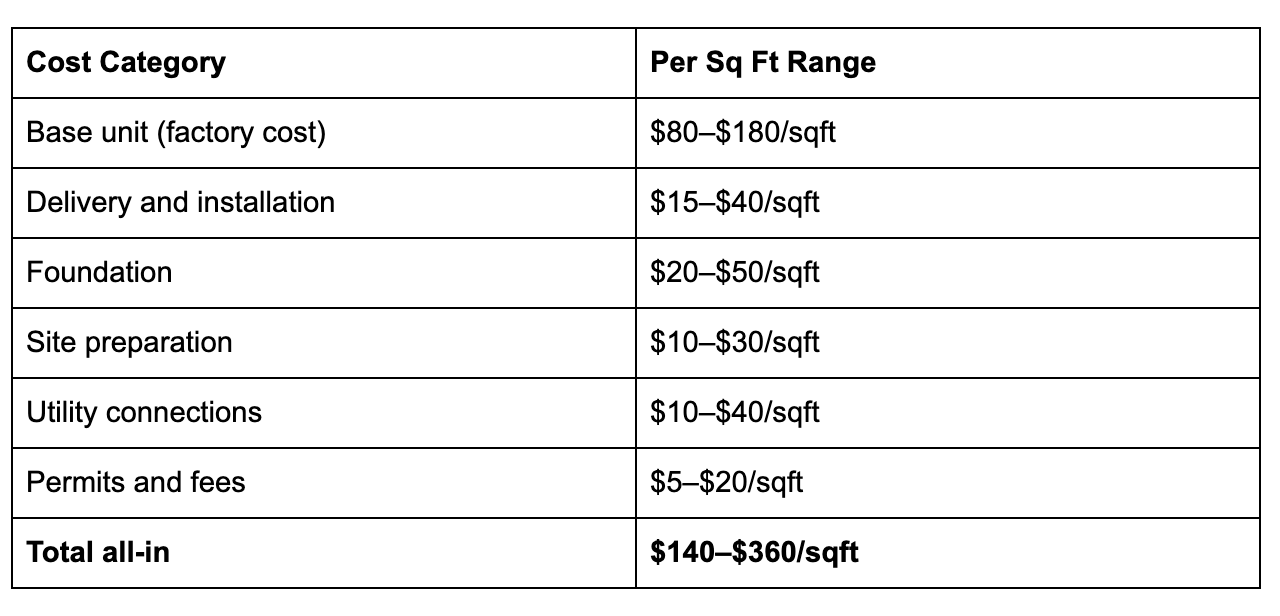
For comparison: site-built construction in the US currently averages $200–$400/sqft depending on region and specification. Modular homes consistently come in at the lower end of that range for equivalent quality.
What Drives Cost Up
Knowing the variables that push modular home prices higher helps you make informed decisions about where to invest and where to economize.
Finish level. The single biggest driver of unit cost after size. Base-specification modular homes use standard-grade cabinetry, laminate countertops, vinyl flooring, and builder-grade fixtures. Premium specifications add hardwood floors, stone countertops, custom cabinetry, high-efficiency appliances, and upgraded mechanical systems. The price difference between base and premium on a 1,400-sqft modular home can easily be $60,000–$100,000.
Number of modules. Each modular section requires its own transportation and crane placement. A home delivered in four modules costs more to set than one delivered in two — more crane time, more connections, more finishing work at the joints.
Site conditions. Sloped terrain, poor soil conditions, remote locations, and difficult delivery access all add to the foundation and site preparation costs. A modular home on a flat, accessible lot in a suburban area costs considerably less to install than the same unit on a steep rural property with a narrow access road.
Geographic location. Labor costs for site work, permitting fees, and impact fees vary significantly by state and county. California and the Pacific Northwest tend to be at the high end; parts of the South and Midwest tend to be lower.
Customization. Standard floor plans from a manufacturer's catalog are priced efficiently. Significant modifications — non-standard window placements, structural changes, custom layout alterations — add design and engineering costs.
What Drives Cost Down
Choosing a standard plan. A manufacturer's standard floor plan comes with pre-prepared engineering drawings, known production costs, and an established supply chain. Choosing from the catalog rather than customizing significantly controls cost.
Minimizing on-site work. The more work done in the factory, the less expensive the on-site completion phase. A nearly complete modular unit that arrives needing only utility connection and minor finishing costs less to complete than a heavily panelized system requiring significant on-site assembly.
Straightforward site conditions. Investing in a site with good access, reasonable slope, and available utilities avoids the cost escalation that comes from difficult site conditions.
International manufacturing. Manufacturers who produce in lower-cost markets — while maintaining quality standards — can offer significantly better value than domestic US production. Prefahb's Bali manufacturing facility is a direct example: skilled craftsmanship at production costs that US manufacturers struggle to match, delivered with a structured process for US buyers.
Container Homes vs. Traditional Modular: How the Costs Compare
It's worth addressing the overlap between container-based prefab homes and traditional modular construction, because buyers researching one often encounter the other.
Traditional modular homes are built in sections from conventional materials — wood framing, standard insulation, drywall — and transported on flatbed trucks to the site. They're classified as real property on permanent foundations and are typically financeable through conventional mortgages.
Container-based prefab homes use steel shipping containers as the structural module. They're often more compact, have a more distinctive aesthetic, and can be configured in ways that conventional modular can't (cantilevered, stacked with offsets, etc.). The all-in cost for a container home is often lower at comparable sizes, particularly at the smaller end of the market.
Prefahb's container-based lineup starts at $29,000 (Model B201) and scales to $195,000+ (Model R404) — price points that compare favorably with conventional modular at equivalent quality levels, with the additional advantages of Bali craftsmanship and the structural resilience of steel construction.
The Hidden Costs Most Buyers Miss
These are the line items that consistently surprise first-time modular home buyers:
Temporary housing during construction. Site preparation and foundation work happen while you're living somewhere. Budget for rental costs during the 8–16 week period between ordering and move-in.
Utility extension costs. In rural properties or lots where utilities aren't already at the building site, extending water, electrical, and sewer/septic service can cost $15,000–$50,000. Get utility extension quotes early — this is where modular home project budgets most commonly blow up.
Landscaping and driveway. The final phase of any site work is often underestimated. A basic gravel driveway and seed-and-mulch landscaping can run $5,000–$20,000. Finished hardscape and planted landscaping costs considerably more.
Appliances and window treatments. Modular homes rarely include appliances in the base price, and never include window coverings. Budget $5,000–$15,000 for a basic appliance package and curtains or blinds.
Moving costs. If you're relocating to the new home, moving costs — often overlooked in the project budget — add $2,000–$10,000 depending on distance and volume.
A Realistic All-In Budget Example
Here's what a 1,200-sqft two-bedroom modular home realistically costs to build and move into in a medium-cost US market in 2026:
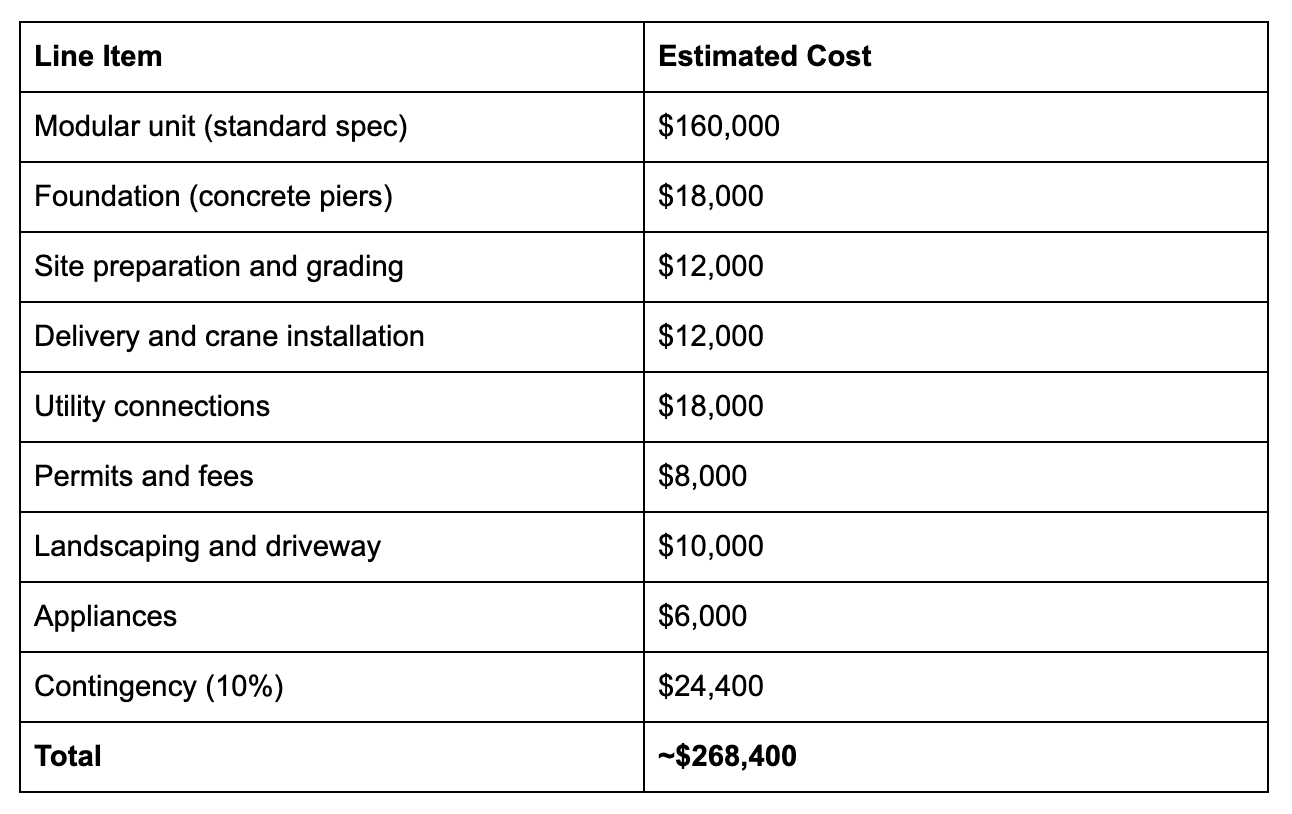
The same home built on-site with a local contractor in the same market: $280,000–$360,000, with a 12–18 month construction timeline versus 10–14 weeks for the modular version.
The savings are real. So is the speed advantage. That combination is why modular and prefab home sales have grown consistently even as the broader new construction market has faced headwinds.
Explore Prefahb's model lineup for container-based alternatives at comparable price points.