
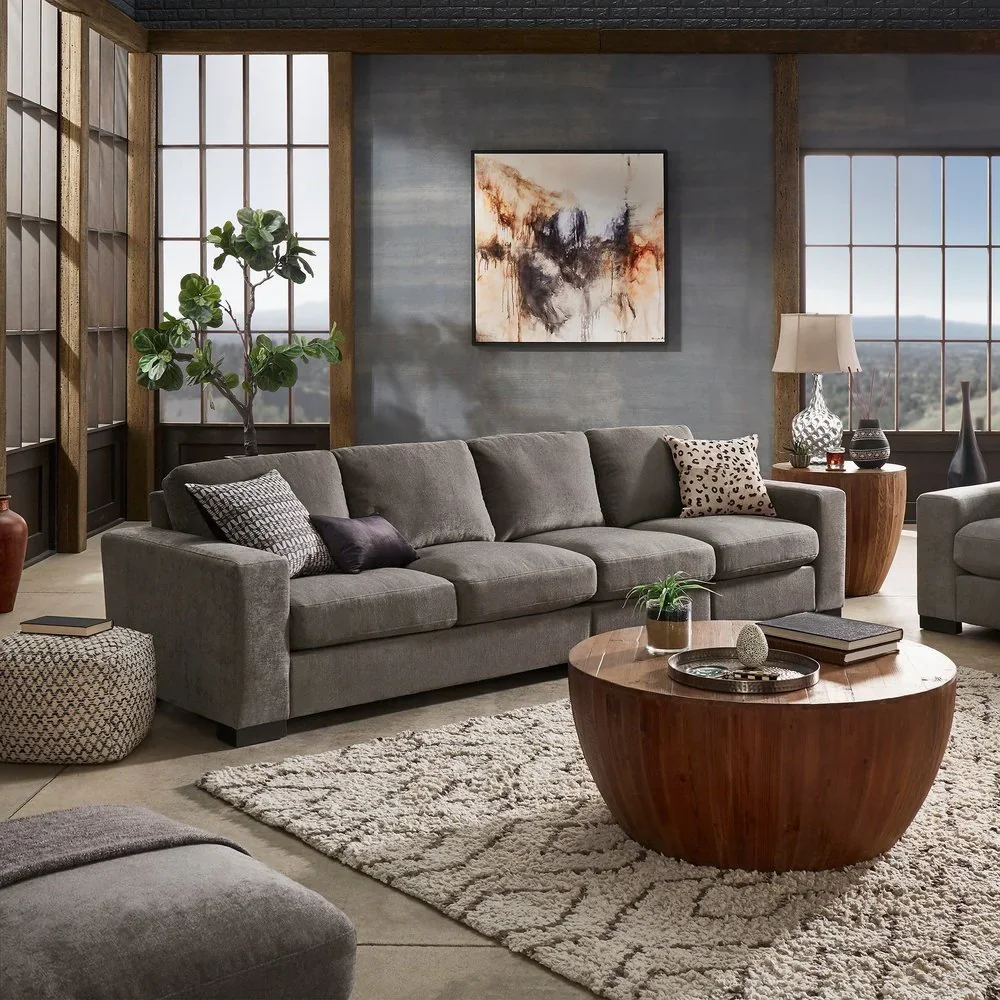
An extra long sofa is the right answer to a specific problem: you regularly seat four or five people, you own a long uninterrupted wall, and a sectional would chop the room into pieces you do not want. It is the wrong answer to almost everything else. Most of the regret around long sofas comes from the same three things: not measuring the path in, not planning the walkway, and not checking the frame. This guide walks through all three.
What Counts as "Extra Long"?
| Category | Length | Typical Seating |
|---|---|---|
| Loveseat | 55"–70" | 2 |
| Standard sofa | 80"–90" | 3 |
| Large sofa | 90"–100" | 3–4 |
| Extra long sofa | 100"–120"+ | 4–5 |
Above 120 inches you are in custom territory, and the physics change: the frame has to span more distance, shipping becomes a project, and the room has to be designed around the piece.
The Room-Fit Math
Do this before looking at fabrics. Take the sofa length and add the following:
Side space: at least 6–12 inches each side if you want a side table or lamp at the ends. Without it, a long sofa feels jammed against corners.
Walkway: 30–36 inches in front of the sofa for traffic, if it separates zones.
Coffee table gap: 14–18 inches between sofa and table.
So a 110-inch sofa with end tables wants a wall of roughly 12 to 13 feet. If the wall is 11 feet, step down to a 96–100 inch sofa and be happy with it.
Four Layouts That Actually Work
Along the longest wall. The obvious choice and the correct one most of the time. Pair it with a long, low console behind it if the sofa floats.
Floating as a room divider. In open-plan spaces, an extra long sofa with its back to the dining area defines the living zone better than a rug alone. Keep the back finished and tidy, since people will see it.
Facing a window wall. Great for views, but check where the TV goes, and be aware of sun fading on the fabric.
Paired with an armchair and ottoman. Instead of a sectional, one long sofa plus a lounge chair creates a conversation arrangement with less visual bulk.
What to Check Inside the Sofa
Length magnifies every weakness in construction. Before buying, look for:
A center support leg. Without one, a 110-inch frame can bow over time.
Hardwood frame, reinforced rails. Kiln-dried hardwood beats engineered board over long spans.
Multiple seat cushions. Three or four cushions distribute wear. A single long slab flattens unevenly.
Firm, resilient foam. Cheap foam compresses fastest on the seats people favor.
The Delivery Problem
This is where many buyers get surprised. Length rarely blocks a doorway; depth and diagonal depth do. Measure every doorway, hallway width, stair turn and elevator, and compare them to the sofa's depth and height (depth is usually 36–42 inches). Then ask whether the legs detach, whether the arms remove, and whether the sofa ships in sections. A modular extra long sofa that arrives in two pieces and locks together is often easier to live with than a one-piece frame that needs a window removed.
Extra Long Sofas in Narrow Homes
Container and modular homes are a good test case, because the shape is unforgiving. A standard container is about 8 feet wide outside and roughly 92 inches wide inside, so a 100-inch sofa cannot span the width, and even a 90-inch one leaves no walkway. The rule in narrow plans is simple: run the sofa along the long wall, never across.
In a larger layout, such as the Model P202 or multi-container Model R404, a 100–110 inch sofa along the living-area wall is entirely realistic and works well with the open plan. In compact models such as the Model B201 (170–340 sqft), a long sofa competes with the murphy bed's footprint, so a more moderate length usually fits better. If you are weighing options, our small modular homes guide covers how living space is typically planned at each size.
How Much Should You Spend?
| Tier | Price | Notes |
|---|---|---|
| Entry | $900–$1,800 | Often engineered frame; check for a center leg |
| Mid-range | $2,000–$4,000 | Hardwood frame, better foam, modular options |
| Premium | $4,500+ | Solid construction, premium upholstery, custom lengths |
Before You Click Buy
Mark the sofa's footprint on the floor with painter's tape and walk around it.
Confirm a center support leg on anything over 100 inches.
Measure the entire delivery route, including turns and stairs.
Prefer modular or removable-leg designs if access is tight.
Decide what happens at both ends: side tables, lamps, nothing.
A long sofa done well gives a room a calm, anchored center; done badly, it becomes the thing you walk around for years. For homes designed with real living space in mind, browse the Prefahb Models & Shop page.